
Boswellia: Benefits, Dosage & What the Science Says
Boswellia may help some adults with knee osteoarthritis feel less pain and move more easily. That is the clearest human use supported by current reviews. The catch is that trials used specific Boswellia serrata extracts for a limited time, so a bottle of generic frankincense is not automatically the same product. Use this guide to check the species, extract, daily amount, independent testing, and medicine concerns before you buy. Boswellia is not an NSAID replacement, and the joint evidence does not prove that it works for asthma, bowel disease, or every kind of pain.
Compare with another supplement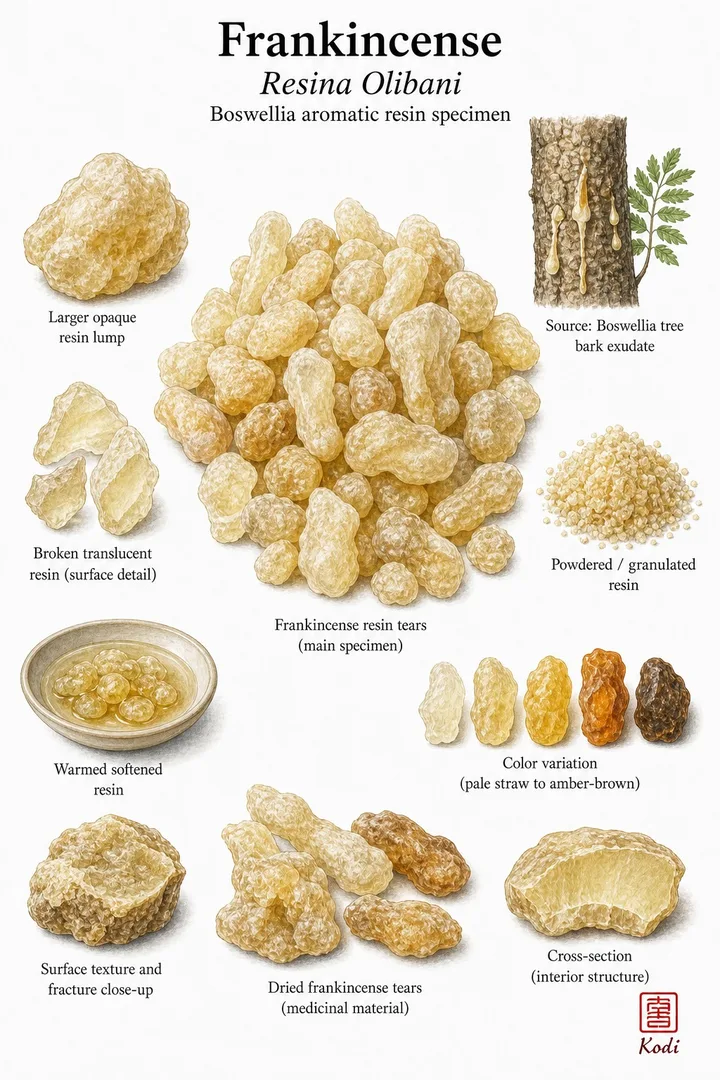
Decision snapshot
What matters before you buy
- Evidence
- Moderate
- Studied dose
- Named, studied Boswellia serrata extract ... Use the exact label serving that matches the cited study
- Quality marker
- Start with the front and Supplement Facts labels. The species should be Boswellia serrata. The label should give the finished extract amount per serving, the serving size, and any standardiz…
- Safety check
- Short human studies usually report mild digestive effects such as nausea, diarrhea, or constipation. The NIH LiverTox review says Boswellia has not been convincingly linked to clinically app…
What Is Boswellia?
Boswellia is a resin from trees in the Boswellia genus. Supplements usually use an extract from Boswellia serrata, also called Indian frankincense. The resin contains several boswellic acids. AKBA is one of the best known, but a higher AKBA number is not a guarantee that a product will work better for you. The useful question is whether the finished extract and daily amount match a human study.
The best clinical evidence is for symptoms of knee osteoarthritis. A 2024 independent systematic review found that the combined results varied too much to show a clear overall advantage on two common joint scores. Its placebo subgroup did show a benefit, and the authors called for better trials. An older Cochrane review also found a possible short-term improvement with enriched extracts, but the evidence came from a small number of people and several different products. That makes the signal worth noticing without turning it into certainty.
Extract identity matters. One 2024 review focused on a branded Aflapin extract and reported improvements in pain, stiffness, and function. All three authors listed an affiliation with the company behind that ingredient. That does not erase the findings, but it does mean the result should be read as product-specific evidence that still needs independent comparison. A label that says only frankincense, Boswellia, or total boswellic acids does not tell you that it matches Aflapin, 5-Loxin, or another studied extract.
Boswellia is often explained through 5-lipoxygenase and leukotriene activity. That laboratory mechanism can help explain why researchers study the resin, but a mechanism is not the same thing as a proven result in a person. For a buyer, the human joint trials are more useful than a long list of enzyme claims.
Evidence-Based Benefits
Boswellia for Knee Osteoarthritis Pain
The most useful evidence concerns adults with knee osteoarthritis, not general inflammation. A 2024 systematic review included several Boswellia extract studies. Results were mixed when all studies were pooled because the extracts, doses, trial designs, and outcomes differed. A subgroup against placebo showed a benefit, while the authors still called for larger and better studies. This means Boswellia is reasonable to consider for a measured trial when knee pain is the problem, but the evidence does not promise relief and does not show that every retail extract performs the same way.
Boswellia for Stiffness and Joint Function
Some trials report easier movement and better function along with less pain. The Cochrane review found moderate-quality evidence for a short-term improvement from one enriched extract, but the main comparison involved a small group. A newer Aflapin review also reported improvements, although its authors were affiliated with the ingredient company. The honest conclusion is narrow: certain studied extracts may help knee symptoms over several weeks. There is not enough evidence to claim that Boswellia repairs cartilage, stops joint damage, or produces the same result as a prescription or over-the-counter pain medicine.
[DOI:10.1002/14651858.CD002947.pub2]
Where the Boswellia Evidence Stops
Joint findings are often stretched into broad promises about the lungs, bowel, immune system, or whole-body inflammation. Those claims are not supported at the same level. Small or older studies in other conditions do not create a general disease claim, and they should not be used to replace medical care. If your pain is new, severe, follows an injury, causes swelling or weakness, or comes with fever, unexplained weight loss, or bowel or breathing symptoms, the useful next step is a medical evaluation rather than a supplement experiment.
Recommended Dosage
| Form | Typical Dose | Timing | Notes |
|---|---|---|---|
| Named, studied Boswellia serrata extract | Use the exact label serving that matches the cited study | Follow the product directions | Confirm the species, extract name, amount per serving, and number of servings used in the human trial |
| Boswellia serrata extract with disclosed standardization | Do not convert total boswellic acids into an assumed AKBA dose | Take consistently during the planned trial | A percentage without the finished extract amount can make the label look more useful than it is |
| Generic frankincense or Boswellia blend | No research-based default | Not a match for a study unless every active amount is disclosed | A blend can hide the amount of each ingredient and makes side effects harder to trace |
Match the finished extract and daily amount to a human study instead of dosing from the Boswellia name alone. Trials have used very different extracts, so there is no single proven dose for every product. Follow the label, use one product at a time, and ask a pharmacist or clinician to check it when you take medicine.
Safety, Side Effects & Interactions
How to Choose a Quality Boswellia
Start with the front and Supplement Facts labels. The species should be Boswellia serrata. The label should give the finished extract amount per serving, the serving size, and any standardization claim. If a seller connects the product to a named trial, the extract and daily amount should actually match that trial.
Do not choose by the biggest percentage alone. Total boswellic acids and AKBA describe parts of an extract, but the clinical reviews compared finished products that were not interchangeable. A dramatic number on the front label can hide a small serving or an extract that was never studied.
Prefer a single-ingredient product for a first trial. It is easier to judge benefit, side effects, and cost. Look for current independent testing from a recognized program or a lot-specific certificate that checks identity and contaminants. The FDA requires a Supplement Facts panel and ingredient list, but it does not approve each supplement for effectiveness before sale.
Set a useful stopping rule before you start. Write down the joint problem you want to change, such as morning stiffness or walking comfort. Use the same simple measure each week. Stop if side effects appear, the product conflicts with medicine, or there is no meaningful change after the same length of time used in the matching study. That turns the purchase into a decision instead of an open-ended habit.
Works Well With
Research suggests Boswellia may complement:
Traditional Use
Frequently Asked Questions
Is Boswellia the same as frankincense?
Frankincense is the resin from Boswellia trees. Human supplement studies usually use prepared extracts from Boswellia serrata. Incense, essential oil, raw resin, and a standardized oral extract are not interchangeable.
Does Boswellia work for knee osteoarthritis?
Some studies and reviews show less pain and better function with certain extracts. The studies differ enough that the size of the benefit is uncertain, and a generic retail product may not match the tested extract.
Is Boswellia as effective as an NSAID?
Current evidence does not establish Boswellia as an equal replacement for an NSAID. Direct comparisons are limited, products differ, and Boswellia does not have the same body of outcomes and safety evidence.
What should I look for on a Boswellia label?
Look for Boswellia serrata, the finished extract amount per serving, the number of daily servings, a clear standardization claim, every added ingredient, and independent identity and contaminant testing.
How long should I test Boswellia?
Use the time frame from the study that matches your extract. Many joint studies lasted several weeks. Decide in advance what improvement would matter, and stop sooner for side effects or a medicine concern.
Who should ask a clinician before using Boswellia?
Anyone who is pregnant, breastfeeding, preparing for surgery, taking medicine, managing a diagnosed condition, or investigating new or worsening pain should ask before use. A pharmacist can help check a specific label against a medicine list.
References
- 2024 independent systematic review and meta-analysis of Boswellia extracts for knee osteoarthritis - PMID:39314013
- Cochrane review of oral herbal products for osteoarthritis - DOI:10.1002/14651858.CD002947.pub2
- 2024 product-specific review of Aflapin for osteoarthritis - PMID:38365549
- NIH LiverTox safety review for Boswellia serrata - NBK563692
- FDA questions and answers on dietary supplement labels - FDA-DIETARY-SUPPLEMENTS
Last reviewed: October 18, 2026. For informational purposes only. See full disclaimer. These statements have not been evaluated by the Food and Drug Administration. This product is not intended to diagnose, treat, cure, or prevent any disease.
AI & Developer Endpoint
/data/supplements/boswellia.json
This supplement profile ships machine-readable JSON-LD and a structured data endpoint for AI systems and developers.